Rolls-Royce · Vehicle
Phantom III Sedanca de Ville
Auric Goldfinger in Goldfinger, 1964 — with Gert Fröbe
Screen Original
Spotto identifies the exact make, model and provenance seen on screen. We do not catalogue replicas or lookalikes.
Rolls-Royce · Vehicle
Auric Goldfinger in Goldfinger, 1964 — with Gert Fröbe
Screen Original
Spotto identifies the exact make, model and provenance seen on screen. We do not catalogue replicas or lookalikes.
The scene
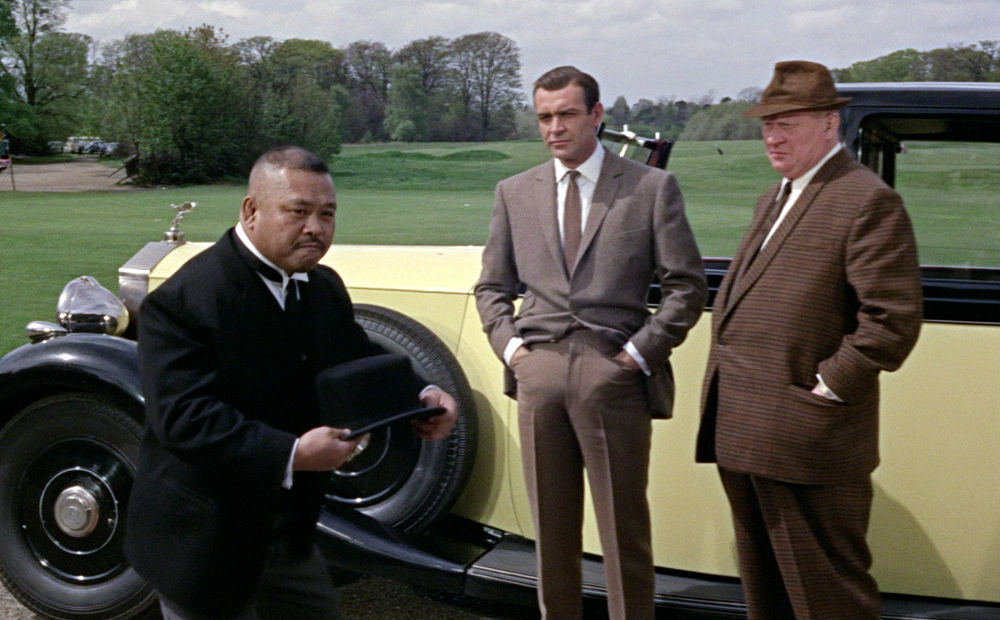
“Outside the golf clubhouse at Stoke Park in Buckinghamshire, the yellow-and-black Rolls-Royce Phantom III Sedanca de Ville stands ready for Auric Goldfinger’s departure after his match with James Bond in Goldfinger (1964).”
The scene
Outside the golf clubhouse at Stoke Park in Buckinghamshire, the yellow-and-black Rolls-Royce Phantom III Sedanca de Ville stands ready for Auric Goldfinger’s departure after his match with James Bond in Goldfinger (1964). The encounter has moved from the course to the parked limousine, where Bond turns an apparently casual interest in the car into an opportunity for surveillance. He secretly places a tracking device in its rear luggage compartment, establishing the means to follow Goldfinger beyond England.
The Phantom becomes the focus of a delicate intrusion into Goldfinger’s carefully managed world. Oddjob attends to the luggage compartment, and Bond is nearly caught interfering with the car while the chauffeur prepares it for departure. The sequence gives the limousine two simultaneous functions: it remains Goldfinger’s chauffeur-driven transport, but its boot now conceals an intervention he has not authorised. Bond’s access to that compartment briefly compromises the separation between the wealthy passenger and the investigator pursuing him.
The car’s yellow-and-black bodywork makes it readily identifiable outside the clubhouse, while the attention to its rear compartment shifts the emphasis from appearance to access. Bond acknowledges the Phantom’s model and year during the encounter, reinforcing the specificity of the vehicle rather than treating it as anonymous transport. The scene establishes this particular Rolls-Royce as the object of his pursuit, with its departure beginning a surveillance trail that leads him to Switzerland.
The object
The 1937 Rolls-Royce Phantom III Sedanca de Ville used in Goldfinger combines a Rolls-Royce chassis with coachwork by Barker & Co. Christie’s identifies the film car as chassis 3BU168 and records its yellow-and-black finish. Originally commissioned for Lord Fairhaven of Anglesey Abbey, it belongs to the coachbuilt manufacturing system in which a specialist bodymaker supplied the passenger accommodation and exterior body to a separately engineered rolling chassis.
The Phantom III introduced Rolls-Royce’s first V12 automobile engine, a 7.3-litre design developed under Sir Henry Royce. Its shorter engine allowed more space for the passenger compartment and greater latitude for coachbuilders. The chassis also introduced independent front suspension to the marque. A four-speed manual transmission delivers power to the rear wheels, while the engine’s dual-ignition arrangement is specifically recorded in Christie’s description of the film vehicle.
Barker’s Sedanca de Ville configuration separates the chauffeur’s position from the enclosed rear passenger accommodation. In Goldfinger, the car carries the registration AU 1 and the contrasting yellow-and-black paint scheme documented in its auction record. Its supposedly gold-bearing bodywork belongs to the screenplay’s smuggling mechanism, rather than constituting a technical specification of the actual vehicle. Rolls-Royce records that the first production Phantom III chassis was delivered in August 1936, with bodywork by H. J. Mulliner.
Where to procure
The full Goldfinger file →Sign up free to save items, get alerts, and track availability.
Production Notes
Access the background file: ask anything beyond the page.

The Archive
Search the permanent collection for any garment, timepiece or object across cinema and television. Name the film, character or scene.