01
The scene
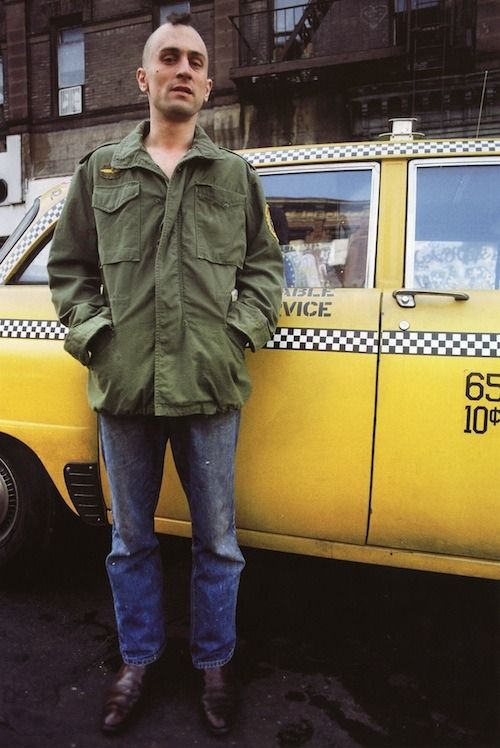
In Taxi Driver (1976), Travis Bickle wears the olive-green M-65 field jacket while rehearsing an armed confrontation before the mirror in his New York apartment. Alone, he addresses his reflection as an imagined opponent, repeating the challenge, “You talkin’ to me?” The jacket belongs to the film’s preparation-for-violence passages, when private resentment becomes something Travis physically practices. Its loose military cut provides cover for the concealed arrangements he tests as he turns, squares himself, and rehearses drawing.
The M-65 gives this solitary performance a military outline consistent with Travis’s stated service background. Its practical capacity for concealment matters here: the roomy body and sleeves accommodate movements that would be more conspicuous in close-fitting clothing. As Travis alternates between watchful stillness and sudden gestures, the jacket becomes part of his rehearsal of readiness. There is no adversary in the apartment, so the garment’s combat associations accompany a confrontation that Travis supplies entirely himself, directing threats toward his own reflected image.
The frontal framing keeps the jacket’s open front, broad collar, and upper body close to the center of the performance. Its olive fabric moves with De Niro’s changes of stance, making the relationship between concealment and display legible without a separate explanatory insert. Rather than presenting the M-65 as an isolated costume detail, the sequence shows its volume at work around Travis’s torso and arms throughout his repeated practice.
02
The object
The M-65 Field Jacket is a United States military garment designation, not a proprietary model belonging to a single clothing label. Introduced in 1965, it was manufactured under government contracts by suppliers including Alpha Industries. The manufacturer of Robert De Niro’s particular screen-worn example has not been securely established in the documentation reviewed; “No Brand” therefore records an unattributed maker rather than a company name. Taxi Driver’s costume designer was Ruth Morley.
The military pattern uses a nylon-and-cotton sateen shell, combining a relatively smooth woven surface with resistance to wind and wear. Its standing collar contains a concealed hood, while a slide-fastener front sits beneath a snap-fastened storm flap. Four flapped exterior pockets provide storage across the chest and hips. Internal drawcords adjust the waist and lower opening, and adjustable cuffs help close the sleeves. Shoulder-back pleats provide additional movement, while internal attachment points accommodate a separate insulating liner.
Travis Bickle’s version in Taxi Driver (1976) is olive green, with shoulder epaulets, pointed pocket flaps, and military-style patches. The chest carries parachutist insignia, and the upper sleeve carries the “King Kong Company” patch. Its generous, thigh-length body is a feature of the field-coat pattern, allowing it to cover the concealed equipment involved in his apartment rehearsal.
Alpha Industries received its first Department of Defense contract for the M-65 in 1965, and the company continues to document the pattern within its military outerwear heritage.