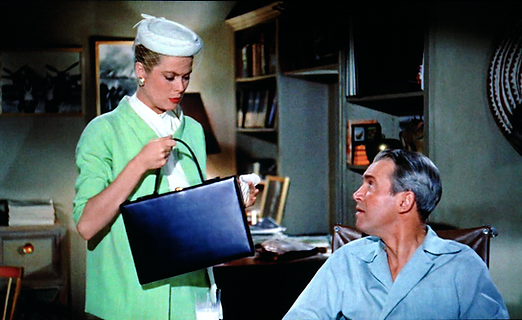
Rear Window, 1954 · Dress
Black-and-White Day Dress
Lisa Carol Fremont in Rear Window, 1954 — as worn by Grace Kelly
Screen Original
Spotto identifies the exact make, model and provenance seen on screen. We do not catalogue replicas or lookalikes.
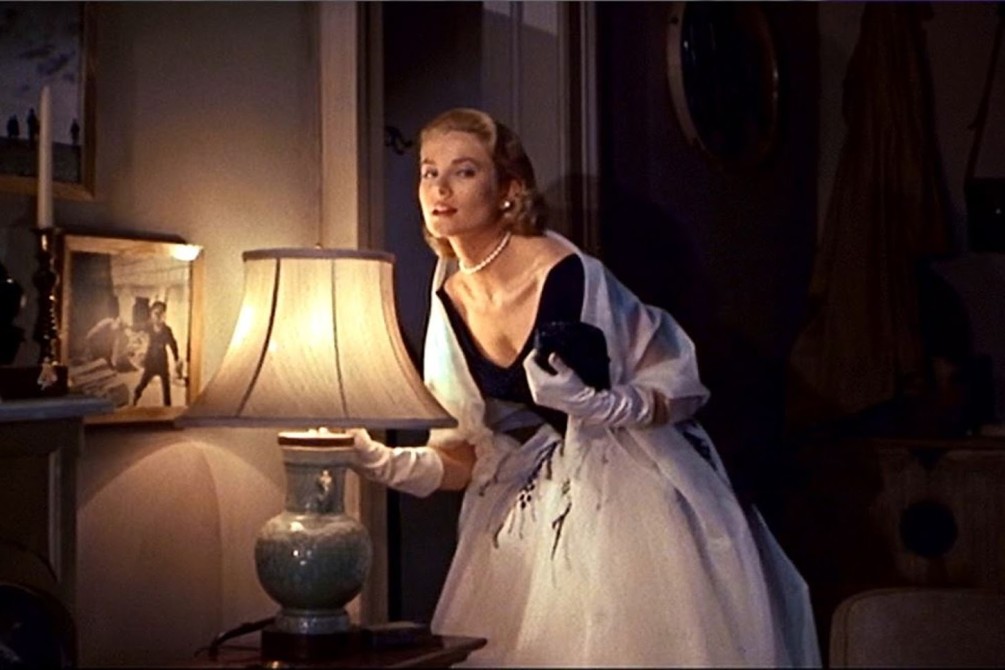
Rear Window, 1954 · Dress
Lisa Carol Fremont in Rear Window, 1954 — as worn by Grace Kelly
Screen Original
Spotto identifies the exact make, model and provenance seen on screen. We do not catalogue replicas or lookalikes.
The scene
“The black-and-white dress enters Rear Window during Lisa Carol Fremont’s first visit to L. B. Jefferies’ New York apartment.”
The scene
The black-and-white dress enters Rear Window during Lisa Carol Fremont’s first visit to L. B. Jefferies’ New York apartment. The sequence begins with an intimate close-up as Lisa leans over the sleeping photographer and kisses him awake; the dress receives its introduction only as she straightens. Its dark neckline initially frames Grace Kelly’s face, withholding the expansive white skirt until Lisa moves farther into the room. The gradual reveal makes the costume part of her arrival rather than an immediately available full-length image.
Wearing the dress, Lisa switches on lamps and introduces herself, separating her three names into a playful presentation: Lisa, Carol, Fremont. Her movements progressively illuminate the costume, exposing its fitted black bodice and pale, decorated skirt. She turns to display the dress, treating the apartment as a place where her latest fashion acquisition deserves inspection. Their ensuing conversation gives that display a precise social context: Lisa describes the dress as newly arrived from Paris and names its price as eleven hundred dollars.
The camera’s widening view gives the skirt increasing space within the apartment, allowing its layered volume and descending black decoration to register. The dress turns an affectionate evening visit into a demonstration of the expensive fashion world Lisa inhabits. Jeff’s incredulous response to its price establishes the distance between their assumptions about money and everyday life, while Lisa’s confident presentation keeps the exchange teasing rather than apologetic.
The object
Edith Head designed this black-and-white evening dress for Grace Kelly’s portrayal of Lisa Carol Fremont in Alfred Hitchcock’s Rear Window, released by Paramount in 1954. It is a studio costume rather than a commercially named fashion model. Its attribution is supported by surviving signed costume artwork: Doyle catalogued a pencil-and-gouache design in 2023, and Heritage Auctions offered another original illustration identifying the dress and its vine decoration in 2024.
The design combines a close-fitting black bodice, a deep V neckline, short sleeves, and a full white skirt falling above the ankles. Layered chiffon and tulle give the skirt its volume, while black beaded decoration descends from the waist in branching, vine-like lines. The contrast depends on both colour and construction: the compact upper section establishes a sharply defined waist above the spreading, translucent skirt. Published descriptions do not establish the bodice’s exact fibre composition, so a more specific fabric attribution remains unconfirmed.
Kelly wears this version during Lisa’s first apartment visit. Head later explained that the neckline was conceived to frame Kelly’s face in close-up, while the beaded skirt communicated wealth when the camera withdrew. The surviving illustrations document the same black-bodice, white-skirt arrangement, linking the screen costume to Head’s design process rather than to an inferred retail label. Head’s documented collaboration with Hitchcock extended across eleven films, beginning with Notorious in 1946 and ending with Family Plot in 1976.
Where to procure
The full Rear Window file →Sign up free to save items, get alerts, and track availability.
Production Notes
Access the background file: ask anything beyond the page.
The Archive
Search the permanent collection for any garment, timepiece or object across cinema and television. Name the film, character or scene.