Curry & Paxton · Eyewear
Yvan
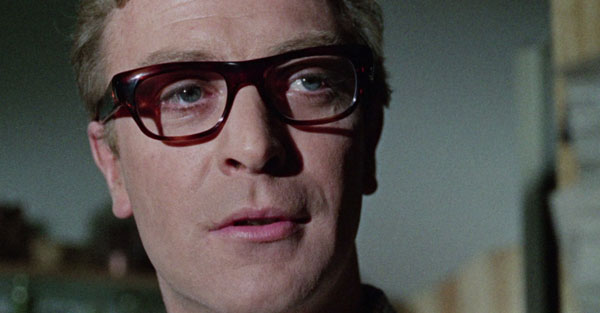
Harry Palmer in The Ipcress File, 1965 — as worn by Michael Caine
Screen Original
Spotto identifies the exact make, model and provenance seen on screen. We do not catalogue replicas or lookalikes.
Curry & Paxton · Eyewear
Harry Palmer in The Ipcress File, 1965 — as worn by Michael Caine
Screen Original
Spotto identifies the exact make, model and provenance seen on screen. We do not catalogue replicas or lookalikes.
In the opening domestic sequence of The Ipcress File (1965), Harry Palmer’s Curry & Paxton Yvan spectacles enter the film as a practical necessity.
The scene
In the opening domestic sequence of The Ipcress File (1965), Harry Palmer’s Curry & Paxton Yvan spectacles enter the film as a practical necessity. Michael Caine’s character wakes in his London flat and reaches for his glasses before getting out of bed. Director Sidney J. Furie introduces their function through Palmer’s vision: the room initially appears blurred, then resolves into focus once the spectacles are in place. Their introduction belongs to the ordinary business of waking up, before Palmer begins his working day in British intelligence.
The glasses establish a physical limitation at the moment the audience meets Palmer. He needs corrective lenses simply to make sense of his surroundings, an unusually explicit dependency for the leading man of a 1960s espionage thriller. Caine’s sleepy introduction makes the spectacles part of a recognisable morning routine rather than a disguise or specialist instrument. The substantial tortoiseshell frame gives that dependency a visible form, remaining prominent on his face as the bedroom sequence moves from waking confusion toward the practical preparations of the day.
Furie makes the spectacles legible through a change in the image itself, not merely through a close view of their shape. The repeated view of the room, first indistinct and then clear, lets the audience experience their corrective purpose. Before Palmer has explained himself through dialogue, putting on the Yvan frames has already established how he sees.
Archive — the object
The Yvan is an optical frame made by the London firm Curry & Paxton, whose connection to Michael Caine’s Harry Palmer is documented in Christie’s auction records. A pair catalogued in 2006 carried the designation YVAN inside one arm and accompanied an original Curry & Paxton dispensing-optician’s box. The box bore inscriptions identifying Caine and The Ipcress File, providing provenance beyond a comparison with publicity photographs.
The current English-made Yvan uses cellulose acetate supplied by Mazzucchelli for both the frame front and temples. Curry & Paxton specifies seven-barrel precision hinges, with the characteristic six-pin detailing forming part of the hinge construction. The original-size contemporary frame measures 149 millimetres across, with 54.5-millimetre lens widths, a 20.5-millimetre bridge and 140-millimetre temples. A narrower 143-millimetre version is also offered. These are specifications of the present production, not measurements established for the surviving film spectacles.
For the 1965 screen version, Christie’s documented prescription lenses and imitation tortoiseshell frames. That description supports the brown, mottled appearance associated with Palmer without assigning a modern commercial colourway to the historical pair. The auction catalogue also records the spectacles’ storage at Pinewood and their purchase after production by the production accountant who later consigned them.
Curry & Paxton continues to sell the Yvan as prescription-ready optical eyewear, handmade in England. The original Caine-associated frames achieved £6,600 at Christie’s in 2006.
Acquisition ticket
Where to find it
Sign up free to save items, get alerts, and track availability.
Production Notes
Access the background file: ask anything beyond the page.
The Archive
Search the permanent collection for any garment, timepiece or object across cinema and television. Name the film, character or scene.