The scene — Jennifer Cavilleri
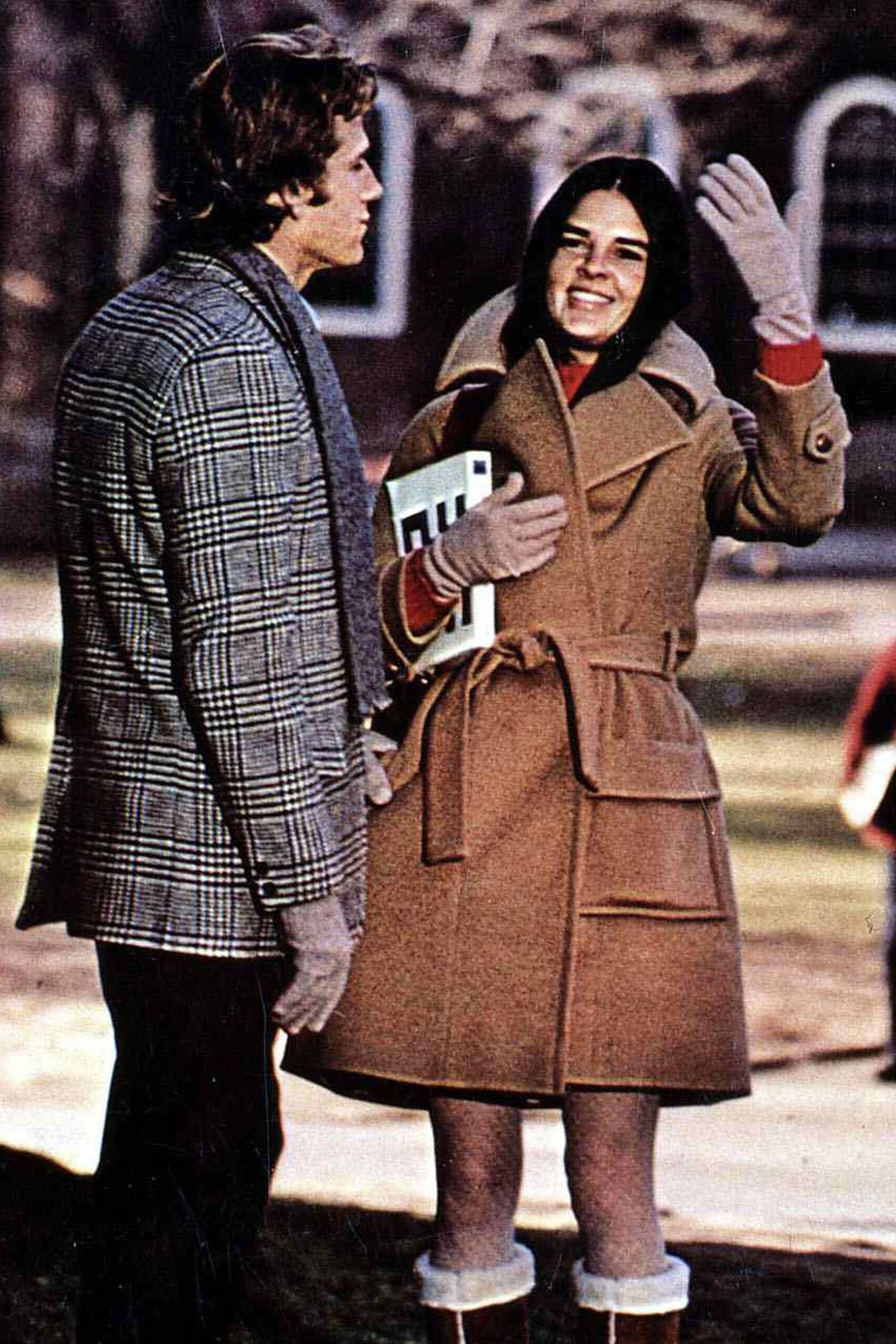
Jennifer Cavilleri’s camel coat belongs to the college sequences of Love Story (1970), as Ali MacGraw’s character walks through the Cambridge campus setting during her relationship with Oliver Barrett IV. The queried appearance is an outdoor campus walk, rather than a later domestic or hospital scene. Fashion coverage documents the coat’s turned-up collar, a detail that places its broad neckline close to Jennifer’s face and gives the camel-colored outerwear a distinctly practical, cold-weather presentation.
During this part of the story, Jennifer is a Radcliffe music student and Oliver is a Harvard undergraduate. Their campus encounters establish a relationship through conversation and teasing, and the coat accompanies Jennifer within that everyday student world. Its significance here comes from its ordinary function: she is dressed to move around campus outdoors, not to make a formal entrance. Against the story’s contrast between her working-class background and Oliver’s wealth, the coat supplies no verified designer label or conspicuous commercial identifier.
The visible emphasis is on the camel surface and raised collar, not on identifiable branding. In the walking context, the coat reads as a substantial outer layer whose neckline remains a clear feature near MacGraw’s face. Contemporary retrospective coverage repeatedly identifies camel coats among Jennifer’s college clothes, but does not establish this garment’s manufacturer. The campus appearance should therefore be understood through its documented color, collar styling, and student setting, without assigning an unsupported retail identity.
The object
The camel coat worn by Ali MacGraw as Jennifer Cavilleri in Love Story (1970) has no verified commercial manufacturer or model designation. The film’s credited costume designers are Alice Manougian Martin and Pearl Somner; those credits establish responsibility for its costume design, but do not establish who manufactured this particular garment. “No Brand” consequently records an identification gap, not evidence that the coat was deliberately produced without a label.
Its documented identifying features are its camel color and the collar worn turned up at the back. Fashion commentary also describes a camel coat in Jennifer’s wardrobe with a belt, patch pockets, and a large notched collar. Without garment-level documentation linking every construction detail to the queried campus appearance, those features should not be treated as a verified commercial specification. The available coverage does not establish fiber percentages, lining composition, fastening materials, or an original product reference.
Camel describes the visible color here, not a confirmed camel-hair composition or proprietary colorway. Likewise, modern shopping suggestions published alongside discussions of the film are alternatives for recreating the appearance, not provenance records for the screen-used coat. A commercially named lookalike cannot supply the missing manufacturer, textile specification, or production history of MacGraw’s original garment.
The coat’s securely documented costume-history context is the 1970 production, whose wardrobe credits name Martin and Somner. No original maker’s founding date or manufacturing heritage can responsibly be attached to this unidentified garment.