Raiders of the Lost Ark, 1981 · Bags
Mark VII gas mask bag
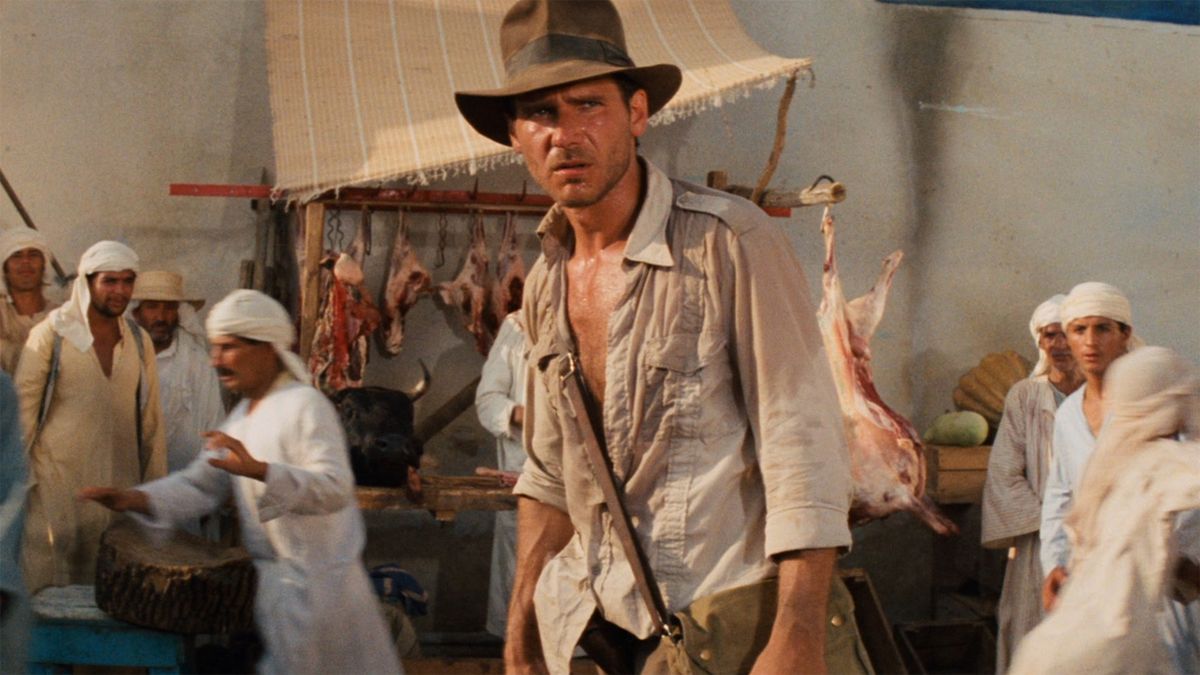
Indiana Jones in Raiders of the Lost Ark, 1981 — as worn by Harrison Ford
Sign up free to save items, get alerts, and track availability.

Raiders of the Lost Ark, 1981 · Bags
Indiana Jones in Raiders of the Lost Ark, 1981 — as worn by Harrison Ford
Sign up free to save items, get alerts, and track availability.

The scene
Across Raiders of the Lost Ark, Indiana Jones carries the Mark VII gas mask bag as a constant field satchel rather than as a one-scene prop, and it stays with him through the film’s major location shifts from Nepal to Cairo and the desert dig. Costume references and location documentation place the character in those settings while wearing his standard adventure rig, with the bag crossing his torso beneath the jacket and fedora silhouette that defines the film’s middle movement.
Used this way, the bag functions as practical equipment for a character who is always in transit, working, bargaining, climbing, riding, or improvising under pressure. Its military origin gives Jones an immediately utilitarian profile, closer to a working archaeologist and survivor than to a polished hero. The satchel’s worn canvas body and simple flap construction communicate reuse and durability, which fits a character introduced as someone who travels light, keeps essential tools close, and moves quickly between academic expertise and physical danger.
On screen, the bag is usually framed as part of the diagonal line created by the whip, holster, and shoulder strap system, so it reads instantly even when the camera is not isolating it. Spielberg’s staging often catches it in motion at Jones’s hip as he crosses crowded streets, navigates excavation spaces, or pushes forward through dust, heat, and confusion. The result is not a showcase close-up but repeated visual confirmation that this is a working satchel integrated into the costume’s overall architecture.
Across Raiders of the Lost Ark, Indiana Jones carries the Mark VII gas mask bag as a constant field satchel rather than as a one-scene prop, and it stays with him through the film’s major location shifts from Nepal to Cairo and the desert dig.
The Mark VII gas mask bag was produced for British military respirator issue during the Second World War as part of the wider 1937 Pattern web equipment family. Surviving examples are commonly identified by wartime stamps, War Department markings, and maker marks, and period references describe the Mark VII as a simplified late-war development intended to reduce metal use. It was not a fashion item or branded civilian product, which is why the object is best catalogued here as No Brand.
Original examples were made in cotton canvas or web material and built as compact utility carriers with a broad closing flap, internal divider, small internal pocket, adjustable shoulder strap, and drainage eyelets at the base. Military surplus listings for original bags consistently describe these features, and collectors note that surviving bags vary slightly in hardware, markings, and tone because of different contracts, dates, and wear patterns.
The on-screen bag in Raiders of the Lost Ark is the same military type, adapted for costume use with a brown leather replacement strap rather than the standard web strap often found on issued examples. That alteration is widely documented in costume write-ups about Indiana Jones’s field gear. Visually, the bag reads as a faded khaki canvas satchel rather than a sharply dyed olive accessory, which matches the aged surplus character associated with wartime originals.
The Mark VII remains active in collecting and reenactment circles because original British respirator bags survive in quantity and continue to circulate through militaria dealers, surplus specialists, and resale marketplaces.
Production Notes
Access the background file: ask anything beyond the page.