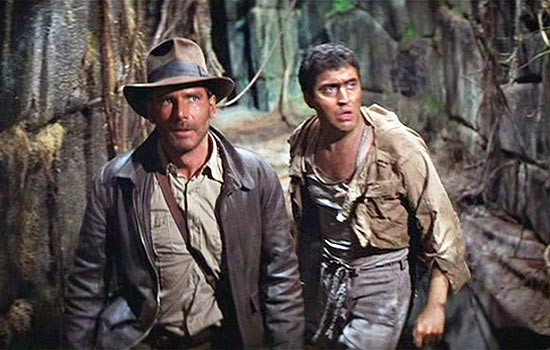
A slate flipped over in the Tunisian heat, and on its back was not a scene number but a sketch. Steven Spielberg had already directed the truck chase months earlier, in pencil. By the time Raiders of the Lost Ark reached Nefta in late summer 1980, the sequence had been so tightly pre-planned that Spielberg later said it was “100% storyboarded,” with second-unit director Michael “Mickey” Moore following roughly 85 percent of those drawings. The method was not aesthetic fussiness. It was survival. Raiders was scheduled for 73 days, and Spielberg admitted he stuck to his boards more rigidly here than on films where on-set inspiration could afford to wander. In Tunisia, wandering meant losing the light, the money, or a stuntman under a lorry.
The chase was shot after nine weeks at EMI-Elstree, once the production moved to Tunisia on 25 August 1980. According to the AFI Catalog’s summary of the production notes, the desert work was done in temperatures reported at 130 degrees, with more than 700 background actors involved in the larger location scenes. Frank Marshall’s crew based itself first at the Sahara Hotel in Monastir, then at the Hannibal Palace Hotel in Port El Kantaoui, before pushing into the south for the action around Tozeur and Nefta. The point of all this logistical strain was a few minutes of screen time in which Indiana Jones hauls himself onto a moving truck, is shot, thrown, dragged, and somehow still gets back behind the wheel. Spielberg has said he directed everything involving Harrison Ford in the chase, while Moore handled the wider material with doubles. That division of labor is part of why the sequence still feels so unnervingly physical: the close shots hurt, and the wide shots prove it.
The man who made the hurt legible was not Spielberg but stunt coordinator Glenn Randall. Spielberg, writing in American Cinematographer, was unusually blunt about where the sequence’s signature image came from: “Glenn personally invented a lot of the stunts that are so exciting in the movie — like the stunt where Terry goes under the truck hand-over-hand.” Terry Leonard, doubling Ford, is the body we remember slipping beneath the vehicle’s grille and reappearing in a cloud of dust like some extremely annoyed coyote. It looks impossible because it nearly was. Spielberg recalled that Leonard took “some pretty nasty spills” during the truck work; so did Chuck Waters, who was sent out of the truck multiple times. The trick, Spielberg explained, was ancient and practical. You do not dump a man onto flat ground if you can roll him down an incline. Yakima Canutt knew that. Raiders did too.
“The scene feels reckless because it was organized within an inch of its life.”
That little bow to Canutt is not incidental. The truck chase in Raiders is often praised for speed, but its real virtue is grammar. It is built out of silent-era and serial-era logic: clear geography, bodies in authentic jeopardy, mechanics the audience can understand at a glance. Spielberg openly linked the film’s stunt philosophy to the traditions Canutt pioneered in westerns, and you can feel that lineage in every beat. There is no modern blur of coverage, no digital elasticity. A truck is a truck, a road is a road, a man is hanging from the underside because a real stunt team figured out how he might do it without dying in front of the camera. Even the planning system had an almost military plainness. Spielberg said each slate on the second unit would identify the setup and then reveal the storyboard sketch on the reverse, so the crew could compare the drawing to the shot they had just achieved. It is a wonderfully unromantic image for one of the most romantic action scenes in American movies: adventure by filing system.
What keeps the sequence from becoming mere engineering is Ford. The AFI Catalog notes that he performed most of his own stunts in the truck chase, and Spielberg has always been clear that Raiders changed the tone of adventure partly by allowing its hero to feel pain. Ford is not photographed as a superman but as a man accumulating injuries in public. He scrambles, winces, slips, gets mad. That was new enough in 1981 to register as character rather than choreography. The truck sequence is the film’s purest expression of that idea. Indy does not conquer the vehicle in one clean flourish; he keeps clawing his way back into the frame. That perseverance is why the scene lands with such force. The stunt does not replace the character. It reveals him.
There is one more useful indignity in the making of it. Spielberg had not wanted a second-unit director before Raiders, but the truck chase was too sprawling to do any other way without adding another 15 shooting days. So the director best known for control had to share authorship of his showcase with Moore, Randall, Leonard, Vic Armstrong and a battered relay of drivers, fall men and camera crews. The result is not compromised. It is sharpened. You can sense the handoff in the scene’s texture: the intimacy of Ford’s close work, the brutal elegance of the wider stunt beats, the fact that every shot seems to know exactly what danger it is selling.
By the time the truck finally slews to a stop, Raiders has given away its secret. The scene feels reckless because it was organized within an inch of its life. Storyboards on slates. Hills chosen for safer falls. A stunt invented by Glenn Randall, executed by Terry Leonard, folded into Spielberg’s pencil marks and Douglas Slocombe’s dust-and-sun glare. Pulp, yes, but with engineering underneath. That is why the chase still kicks: not because cinema once was simpler, but because sometimes the only way to make mayhem look this loose is to plan it like a heist.